The Current EV Landscape in India
India’s electric vehicle market has witnessed significant growth in recent years, driven by government policies and increasing environmental awareness. Key developments include:
- FAME Scheme: The Faster Adoption and Manufacturing of Hybrid and Electric Vehicles (FAME) scheme has provided subsidies and incentives for EV adoption
- Production-linked Incentive (PLI) Scheme: Government incentives for domestic manufacturing of advanced chemistry cell (ACC) batteries
- State Initiatives: States like Delhi, Karnataka, and Tamil Nadu have introduced their own EV policies
- Industry Players: Both domestic manufacturers (Tata, Mahindra) and international companies (MG, Hyundai) have launched EV models in India
Despite this progress, EVs still represent a small fraction of total vehicle sales in India, with most adoption concentrated in 2-wheelers and 3-wheelers.
Future Scope and Opportunities
The future of electric vehicles in India looks promising, with several opportunities on the horizon:
- Significant reduction in air pollution in major cities
- Lower carbon emissions, especially as the grid becomes greener
- Reduced noise pollution in urban areas
- Reduction in oil import dependence, saving foreign exchange
- Job creation in the EV manufacturing and charging infrastructure sectors
- Growth of domestic battery manufacturing capabilities
- Development of indigenous battery technology
- Advancements in charging infrastructure
- Integration with renewable energy sources
Major Challenges Ahead
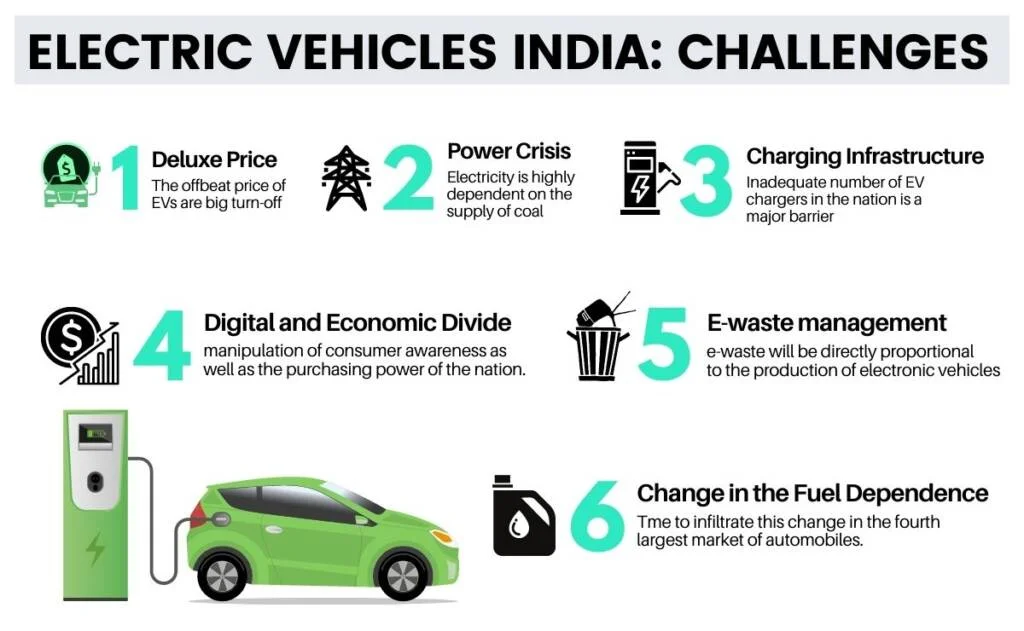
Despite the promising future, several challenges need to be addressed for widespread EV adoption in India:
- Charging Infrastructure: Insufficient public charging stations, especially in tier-2 and tier-3 cities
- Charging Time: Long charging times compared to refueling conventional vehicles
- Grid Capacity: Need for grid upgrades to handle increased electricity demand
- High Initial Cost: EVs are still more expensive than conventional vehicles
- Range Anxiety: Limited driving range compared to petrol/diesel vehicles
- Battery Replacement Cost: Expensive battery replacement after warranty period
- Need for better battery technology with higher energy density
- Standardization of charging connectors and protocols
- Lack of skilled technicians for EV maintenance
Government Initiatives and Policies
The Indian government has introduced several initiatives to promote EV adoption:
- National Electric Mobility Mission Plan (NEMMP) 2020
- FAME India Scheme Phase I and II
- Production Linked Incentive (PLI) Scheme for ACC manufacturing
- Revamped FAME Scheme with increased incentives for electric buses and two-wheelers
- Green Energy Corridor for renewable energy integration
The Road Ahead
With continued government support, technological advancements, and increasing consumer awareness, India’s EV market is expected to grow significantly:
- Target of 30% EV sales by 2030 for private cars
- Complete electrification of public transportation in major cities
- Development of a robust charging infrastructure network
- Integration of EVs with smart grid technologies