Introduction
A circuit breaker is an automatically operated electrical switch designed to protect an electrical circuit from damage caused by overcurrent, short circuits, or fault conditions. Unlike a fuse, which operates once and then must be replaced, a circuit breaker can be reset (either manually or automatically) to resume normal operation.
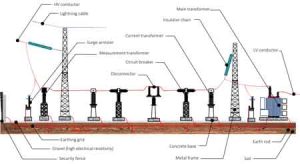
Circuit breakers are essential components of electrical power systems, serving as the first line of defense against electrical faults. They play a critical role in maintaining system reliability by quickly isolating faulty sections while allowing the rest of the system to continue operating.
The primary functions of circuit breakers include:
- Protection: Safeguarding electrical equipment from damage due to excessive currents
- Control: Providing a means to manually open or close circuits under normal conditions
- Isolation: Creating a visible gap for maintenance and safety purposes
- System Stability: Maintaining power system stability by quickly clearing faults
Working Principle
A circuit breaker operates through a coordinated sequence of events when it detects an overcurrent or fault condition:
- Fault Detection: The trip unit (relay or sensor) detects an overcurrent, short circuit, or other abnormal condition
- Signal Transmission: The trip unit sends a signal to the operating mechanism
- Mechanical Separation: The operating mechanism rapidly separates the circuit breaker contacts
- Arc Formation: As the contacts separate, an electric arc forms between them
- Arc Extinction: An arc-quenching medium safely extinguishes the arc to stop current flow
- Contact Separation: Contacts move to their fully open position, creating a visible gap
The key challenge in circuit breaker design is safely interrupting the arc that forms when contacts separate. This arc can reach temperatures of several thousand degrees Celsius and must be quickly extinguished to prevent damage and ensure safety.
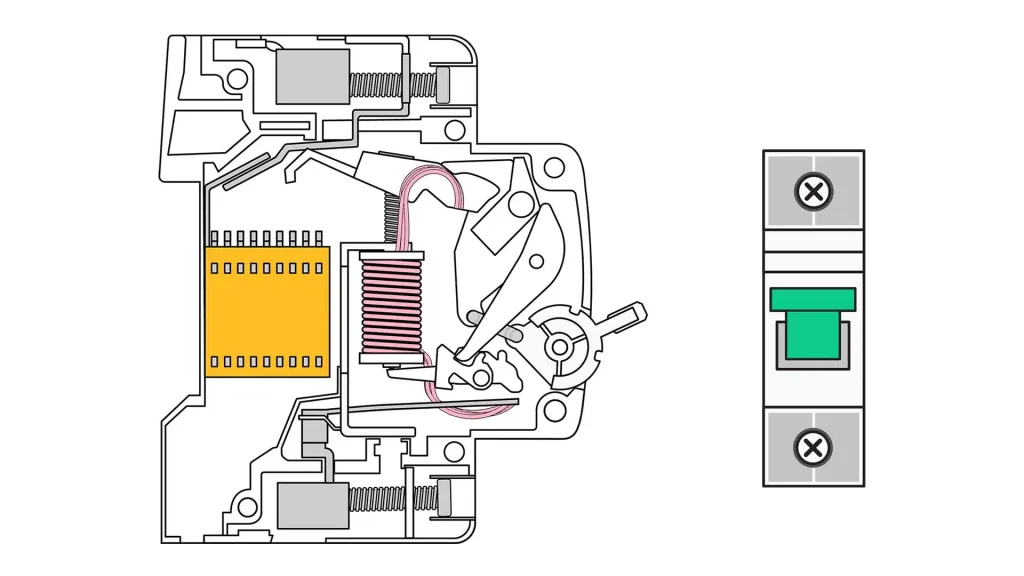
- Contacts: Fixed and moving contacts that make and break the circuit
- Operating Mechanism: Provides the force needed to open and close contacts
- Arc Quenching Medium: Medium used to extinguish the arc (oil, air, vacuum, or SF6 gas)
- Trip Unit: Detects fault conditions and initiates breaker operation
- Housing: Enclosure that contains all components and provides insulation
Types of Circuit Breakers
Circuit breakers are classified based on several criteria, with the arc-quenching medium being the primary differentiator. Different types are suited for different voltage levels and applications:
1. Oil Circuit Breakers (OCB)
Oil circuit breakers use insulating oil (typically transformer oil) as both the arc-quenching medium and insulation between contacts.
Operating principle:
- When contacts separate, an arc forms in the oil
- The arc vaporizes the oil, creating gas bubbles with high dielectric strength
- The gas bubbles help cool and extinguish the arc
Advantages:
- Effective arc quenching properties
- Good insulation characteristics
- Relatively inexpensive
Disadvantages:
- Fire hazard due to flammable oil
- Requires regular maintenance and oil testing
- Slower operation compared to modern breakers
2. Air Circuit Breakers (ACB)
Air circuit breakers use compressed air or normal air pressure to extinguish the arc. They are commonly used in low to medium voltage applications.
Operating principle:
- Compressed air is directed at the arc to cool and stretch it
- The increased length and cooling cause the arc to extinguish
Applications:
- Low voltage distribution panels (MCCBs)
- Medium voltage switchgear
- Industrial and commercial installations
3. Vacuum Circuit Breakers (VCB)
Vacuum circuit breakers use a vacuum as the arc-quenching medium. The contacts are enclosed in a vacuum bottle or interrupter.
Operating principle:
- Contacts separate in a vacuum environment (10^-6 to 10^-9 torr)
- The arc forms but quickly extinguishes due to lack of ionizable particles
- Metal vapor from contacts condenses rapidly on the shield
Advantages:
- Fast operation and high dielectric strength
- Long contact life with minimal maintenance
- No fire hazard or environmental concerns
- Compact size and quiet operation
Applications:
- Medium voltage distribution (up to 38kV)
- Frequent switching applications
- Indoor installations where space is limited
4. SF6 Circuit Breakers
SF6 (Sulfur Hexafluoride) circuit breakers use SF6 gas as the arc-quenching medium. SF6 has excellent insulating and arc-quenching properties.
Operating principle:
- SF6 gas has high dielectric strength and excellent thermal conductivity
- The gas captures free electrons, preventing arc restriking
- Gas pressure is typically 5-7 times atmospheric pressure
Advantages:
- Superior arc-quenching properties
- Long maintenance intervals
- Compact design for high voltage applications
Disadvantages:
- SF6 is a potent greenhouse gas
- Requires specialized handling and recycling
- Higher initial cost
Applications:
- High voltage transmission systems (72kV and above)
- Systems requiring frequent operations
- Applications where compact size is critical
Circuit Breaker Ratings
Circuit breakers are specified by several important ratings that determine their application and performance:
- Rated Voltage: Maximum voltage at which the breaker can operate safely
- Rated Current: Continuous current the breaker can carry without overheating
- Rated Short-Circuit Current (Breaking Capacity): Maximum fault current the breaker can interrupt
- Making Capacity: Maximum current the breaker can safely close onto
- Operating Sequence: Standard duty cycle (O – t – CO – t – CO)
SAFETY NOTE: Circuit breakers handle extremely high voltages and currents that can cause serious injury or death. Only qualified electrical professionals should install, maintain, or operate circuit breakers. Always follow proper lockout/tagout procedures and safety protocols when working with electrical equipment.
Conclusion
Circuit breakers are indispensable components of modern electrical power systems, providing essential protection against overcurrents and faults. Their ability to automatically detect abnormal conditions and quickly interrupt current flow prevents equipment damage, reduces fire hazards, and maintains system stability.
The choice of circuit breaker type depends on several factors including voltage level, fault current requirements, environmental conditions, and maintenance considerations. Modern circuit breakers incorporate advanced technologies such as digital protection relays, communication capabilities, and predictive maintenance features.
As power systems continue to evolve with the integration of renewable energy sources, smart grid technologies, and distributed generation, circuit breakers are adapting with improved performance, communication capabilities, and compatibility with automated control systems. Understanding their operation and characteristics is essential for electrical engineers involved in power system design, operation, and maintenance.