Introduction to Instrument Transformers
Instrument transformers are essential components in electrical power systems that serve the critical function of stepping down high voltages and currents to safe, measurable levels. These devices enable the use of standard measuring instruments, protective relays, and control equipment with high-voltage power systems.
The two primary types of instrument transformers are:
- Current Transformers (CTs): Step down high currents to lower, standardized values
- Potential Transformers (PTs): Step down high voltages to lower, standardized values
Both types of transformers operate on the same fundamental principle of electromagnetic induction but are designed and connected differently to serve their specific purposes in power systems.
Current Transformer (CT)
A Current Transformer (CT) is an instrument transformer specifically designed to produce a current in its secondary winding that is accurately proportional to the current flowing in its primary winding. CTs are essential for metering, protection, and monitoring of electrical power systems.
- Function: Steps down current from primary to secondary
- Connection: Connected in series with the circuit being measured
- Primary Winding: Usually consists of one or few turns (sometimes just a bus bar)
- Secondary Winding: Many turns of fine wire to produce the required current ratio
The primary winding of a CT carries the full load current of the circuit being measured. The secondary winding, with many more turns, produces a current that is a precise fraction of the primary current according to the turns ratio:
Where Ip = Primary current, Is = Secondary current, Np = Primary turns, Ns = Secondary turns
IMPORTANT: The secondary of a current transformer must never be left open-circuited when primary current is flowing. This can result in extremely high voltages across the secondary terminals, posing serious safety hazards and potentially damaging the transformer.
- Current measurement with ammeters
- Energy metering in watt-hour meters
- Protective relaying for overcurrent protection
- Monitoring and control systems
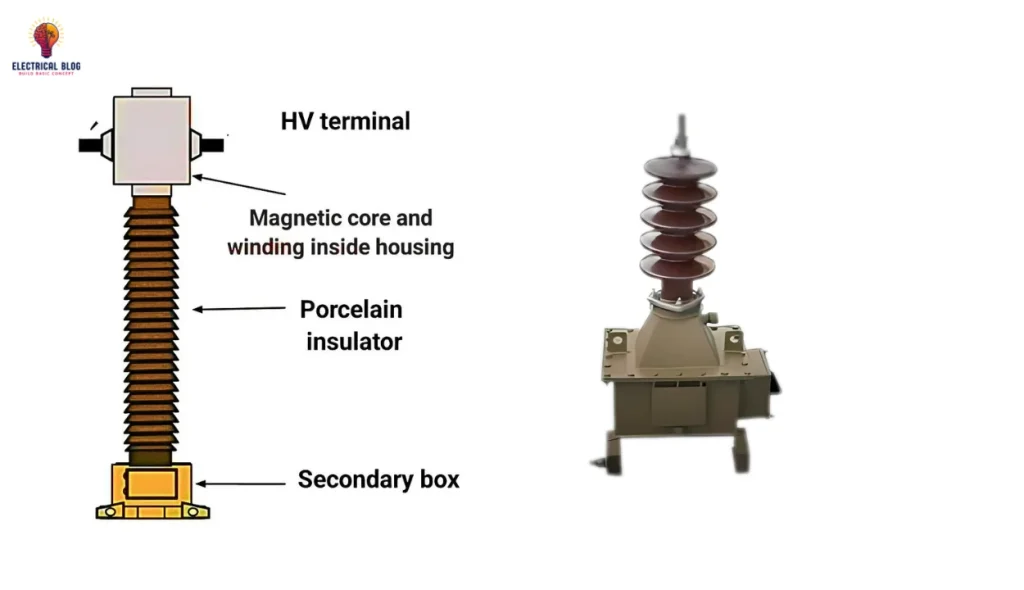
Potential Transformer (PT)
A Potential Transformer (PT), also known as a Voltage Transformer (VT), is an instrument transformer designed to produce a voltage in its secondary winding that is accurately proportional to the voltage applied to its primary winding. PTs are essential for voltage measurement and protection in high-voltage systems.
- Function: Steps down voltage from primary to secondary
- Connection: Connected in parallel with the circuit being measured
- Primary Winding: Many turns of fine wire to handle high voltage
- Secondary Winding: Fewer turns to produce the required voltage ratio
The primary winding of a PT is connected across the high-voltage line. The secondary winding produces a voltage that is a precise fraction of the primary voltage according to the turns ratio:
Where Vp = Primary voltage, Vs = Secondary voltage, Np = Primary turns, Ns = Secondary turns
Unlike CTs, the secondary of a PT can be safely open-circuited since it operates like a normal transformer. However, the primary is still connected to high voltage, so proper safety precautions must always be observed.
- Voltage measurement with voltmeters
- Energy metering for kilowatt-hour calculation
- Protective relaying for overvoltage/undervoltage protection
- Synchronization of generators
Summary Table
| Parameter | Current Transformer (CT) | Potential Transformer (PT) |
|---|---|---|
| Primary Function | Steps down current | Steps down voltage |
| Connection | Series with circuit | Parallel with circuit |
| Primary Current | Full load current | Negligible (magnetizing current) |
| Secondary Rating | Usually 5A or 1A | Usually 110V or 120V |
| Open Circuit on Secondary | Dangerous – Must Never Be Open | Safe – Can Be Opened |
| Core Construction | Large cross-section for low leakage | Normal transformer core |
| Primary Winding | Few turns (sometimes 1 turn) | Many turns of fine wire |
Conclusion
Both Current Transformers and Potential Transformers are indispensable in modern power systems, providing the interface between high-power circuits and low-power measurement/protection equipment. Understanding their differences is crucial for proper selection, installation, and maintenance:
- CTs are designed for accurate current transformation and must never have their secondary open-circuited
- PTs are designed for accurate voltage transformation and can safely have their secondary open-circuited
- Both transformers enable safe and accurate monitoring of high-voltage power systems
Proper application of these instrument transformers ensures reliable operation of power systems while protecting personnel and equipment from the dangers of high voltage and current levels.