Introduction
A fault in an electrical power system is an abnormal condition that disrupts the normal flow of current. Faults can cause equipment damage, power outages, and safety hazards if not quickly detected and cleared. Understanding the different types of faults is essential for designing effective protection systems and maintaining power system reliability.
Faults in power systems are characterized by:
- Abnormal Current Flow: Current levels that exceed normal operating conditions
- Voltage Disturbances: Deviations from normal voltage levels
- System Imbalance: Unbalanced conditions in three-phase systems
- Equipment Stress: Mechanical and thermal stresses on system components
Power system protection engineers classify faults to design appropriate protection schemes that can quickly detect and isolate faulted sections while maintaining service to unaffected areas.
Symmetrical Faults
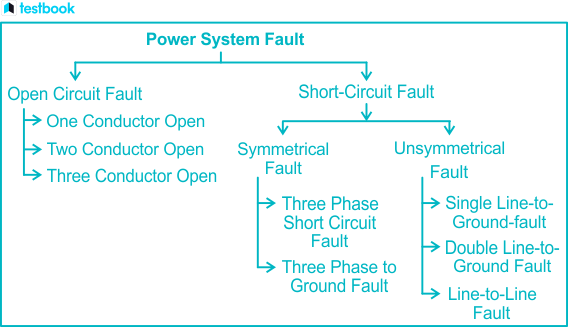
Symmetrical faults, also known as balanced faults, affect all three phases of a power system equally. These faults maintain the balanced nature of the three-phase system but cause excessive current flow.
Three-Phase Fault (LLL)
A three-phase fault occurs when all three phases are short-circuited together, either with or without a connection to ground. This is the most severe type of fault from a theoretical standpoint because it produces the highest fault currents.
Characteristics:
- Affects all three phases symmetrically
- Maintains system balance despite the fault
- Produces the highest fault current magnitude
- Relatively rare (accounts for less than 5% of all faults)
Despite being the most severe, three-phase faults are the easiest to analyze because they maintain system symmetry. Protection systems are typically designed to handle these faults as the worst-case scenario.
Unsymmetrical Faults
Unsymmetrical faults, also known as unbalanced faults, affect the three phases unequally. These faults are more common than symmetrical faults and create unbalanced conditions that require more complex analysis methods.
1. Single Line-to-Ground Fault (LG)
A single line-to-ground fault occurs when one phase conductor comes into contact with ground or a grounded object. This is the most common type of fault in power systems.
Characteristics:
- Involves only one phase and ground
- Creates significant system imbalance
- Accounts for 70-80% of all transmission line faults
- Generally produces lower fault currents than three-phase faults
These faults are often caused by insulation failure, lightning strikes, or physical contact with grounded objects like tree branches.
2. Line-to-Line Fault (LL)
A line-to-line fault occurs when two phase conductors are short-circuited together without involving ground. This type of fault is less common than single line-to-ground faults but more severe.
Characteristics:
- Involves two phases shorted together
- No direct connection to ground
- Accounts for approximately 10-15% of all faults
- Produces higher fault currents than line-to-ground faults
Line-to-line faults typically result from insulation failure between phases or physical contact between conductors due to wind or mechanical failure.
3. Double Line-to-Ground Fault (LLG)
A double line-to-ground fault occurs when two phase conductors are short-circuited together and also connected to ground. This is one of the most severe unsymmetrical faults.
Characteristics:
- Involves two phases and ground connection
- Creates complex system imbalance
- Accounts for approximately 10-15% of all faults
- Produces fault currents between single line-to-ground and three-phase faults
These faults often result from mechanical failure that brings two conductors into contact with each other and a grounded structure.
Fault Classification Table
| Fault Type | Symbol | Frequency | Severity |
|---|---|---|---|
| Three-Phase Fault | LLL | Less than 5% | Highest |
| Single Line-to-Ground | LG | 70-80% | Lowest |
| Line-to-Line | LL | 10-15% | Medium |
| Double Line-to-Ground | LLG | 10-15% | High |
Causes and Consequences
Electrical faults in power systems can be attributed to several causes:
- Natural Causes: Lightning strikes, wind damage, ice loading, and animals
- Equipment Failure: Insulation breakdown, mechanical failure, or aging components
- Human Error: Mistakes during maintenance or switching operations
- Environmental Factors: Pollution, salt spray, or vegetation contact
Faults in power systems can have serious consequences if not quickly cleared:
- Thermal Effects: Excessive current causes heating that can damage conductors and insulation
- Mechanical Forces: High fault currents create electromagnetic forces that can damage equipment
- Voltage Fluctuations: Faults cause voltage dips that affect sensitive equipment
- System Instability: Large faults can cause generators to lose synchronism
- Power Outages: Faults may result in loss of service to customers
Fault Detection and Clearing
Power systems employ sophisticated protection schemes to detect and clear faults quickly:
- Overcurrent Relays: Detect excessive current flow
- Differential Relays: Compare currents entering and leaving a protected zone
- Distance Relays: Measure impedance to detect faults along transmission lines
- Ground Fault Relays: Detect ground fault currents in grounded systems
- Circuit Breakers: Automatically interrupt fault currents
- Fuses: Simple overcurrent protection devices
- Reclosers: Automatically retry circuit restoration after temporary faults
The goal of protection systems is to clear faults as quickly as possible (typically within a few cycles) to minimize damage and maintain system stability.
Conclusion
Understanding the different types of faults in power systems is fundamental to designing effective protection schemes and maintaining reliable electrical service. While three-phase faults are the most severe from a theoretical standpoint, single line-to-ground faults are the most common in practice.
Power system protection engineers must account for all fault types when designing protection schemes, ensuring that protective devices can detect and clear faults quickly while minimizing disruption to unaffected parts of the system. Modern digital protection systems use advanced algorithms to accurately detect and classify faults, enabling faster and more selective fault clearing.
As power systems become more complex with the integration of renewable energy sources and distributed generation, fault analysis and protection continue to evolve with new technologies and methodologies to maintain system reliability and safety.